6 min read
Your bottleneck isn't the model. It's the other 90%.
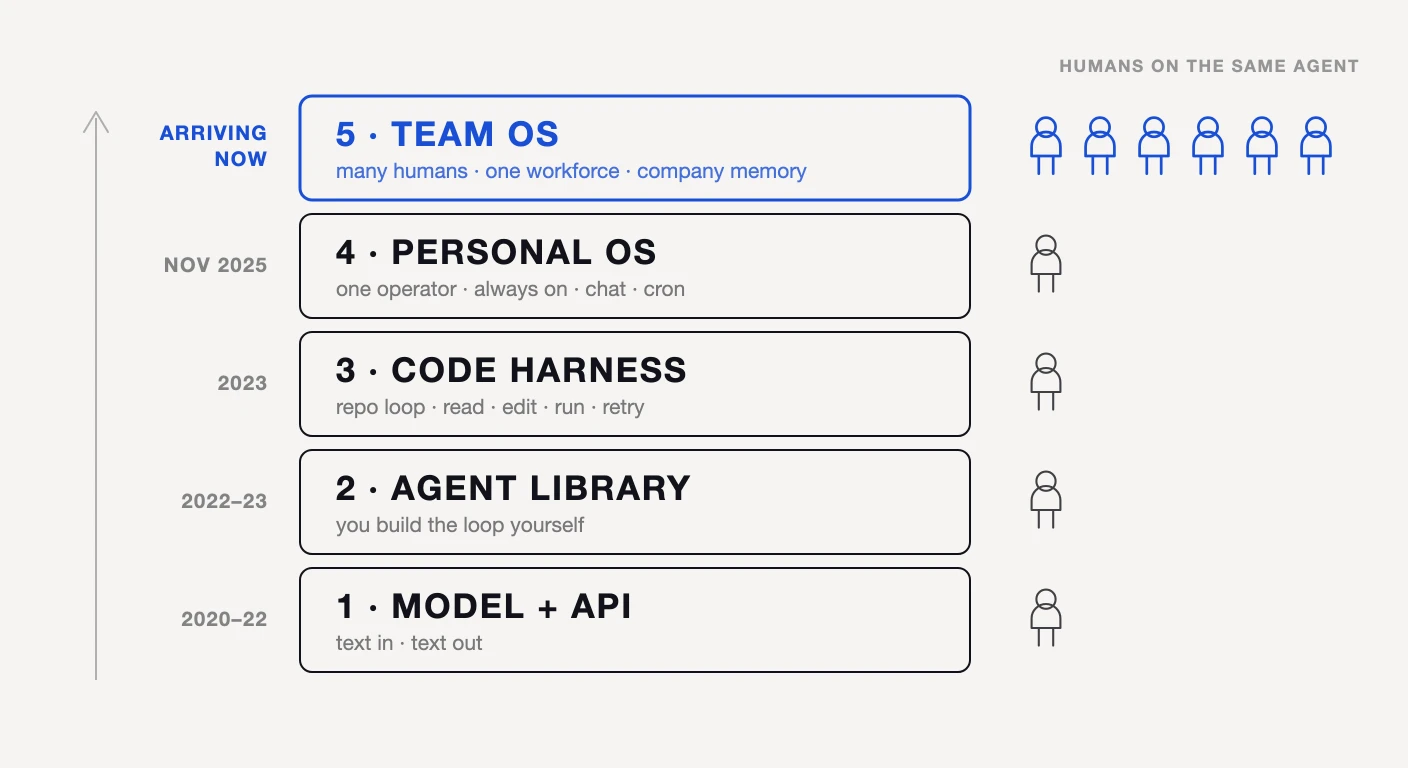
Every company has a top 10% who run Claude Code, OpenClaw and Cowork like a team of engineers — and a 90% still typing questions into ChatGPT. That gap, not model quality, is what caps output.
TL;DR
- The models are already good enough. What’s capping your output is skill distribution, not capability.
- In every company I’ve audited, roughly 10% of people are AI-fluent and 90% are still doing single-turn Q&A in a chat box.
- The 90% aren’t lazy. They’ve never been shown what a skill, a connector, or an agent actually is.
- Training doesn’t close the gap — the tooling changes faster than any workshop cycle.
- The only thing that closes it: a shared workspace where the fluent 10% build the agents and the other 90% use the same ones.
The wrong diagnosis
Ask an exec why AI hasn’t moved their numbers and you’ll get some version of: “the models aren’t there yet.” They tried an agent, it hallucinated a contract clause, and the conclusion was that AI employees are a 2027 problem.
That diagnosis is wrong, and it’s expensive because it justifies waiting.
Inside the same company, someone in engineering is running Claude Code across three repos, shipping features that used to take a sprint. Someone in ops has an OpenClaw instance answering support tickets overnight. Same models. Same subscription tier. Wildly different output.
If the model were the constraint, everyone in the building would be stuck at the same ceiling. They’re not. The variance is inside the company, not inside the model.
The 10/90 split
Here’s the shape of it in practice:
| The 10% | The 90% | |
|---|---|---|
| Tools | Claude Code, OpenClaw, Cowork, API | ChatGPT web, sometimes Copilot |
| Interaction | Delegates a goal, walks away | Types a question, waits for a paragraph |
| Context | Repo, docs, CRM, inbox wired in | Copy-pastes into the prompt box |
| Reuse | Writes skills, schedules them | Retypes the same prompt every week |
| Failure mode | Debugs the harness | Concludes “AI got it wrong” |
| Output | 5–10× their pre-AI baseline | 1.1× — faster emails |
The 10% aren’t smarter. They crossed a specific set of concepts that nobody ever explained to the other 90%:
- A skill is a written procedure the AI follows every time — your SOP, in a file, versioned. Not a prompt you retype.
- A connector is standing access to a real system — Gmail, Drive, the CRM, the DB. Not a screenshot pasted into the chat.
- A subagent is a second AI you hand a scoped job to, so the main one doesn’t blow its context.
- Scheduling means the work runs at 6am without anyone opening a browser.
- Context is a budget you manage, not an infinite bucket.
None of that is hard. All of it is invisible if nobody shows you. And the entire productivity delta lives in those five bullets.
Why training doesn’t fix it
The reflex is to buy training. Half-day workshop, a Notion page of best-practice prompts, an internal champion, done.
It decays in six weeks. Three reasons:
- The tooling ships faster than the curriculum. What you taught in March is deprecated in May. The workshop teaches prompt tricks; by the time it’s delivered the frontier has moved to agents, connectors, and scheduled skills.
- Prompting isn’t the skill. You can’t document your way to fluency any more than you can document your way to being a good manager. The 10% got there by running the loop daily for months — delegate, watch it fail, correct, retry.
- Nothing persists. Everything the trained person learns lives in their own chat history. The person next to them starts from zero. There’s no artifact, so there’s no compounding.
You end up paying to raise the 90% by 10%, once, while the 10% keeps pulling away.
Stop distributing knowledge. Distribute the agent.
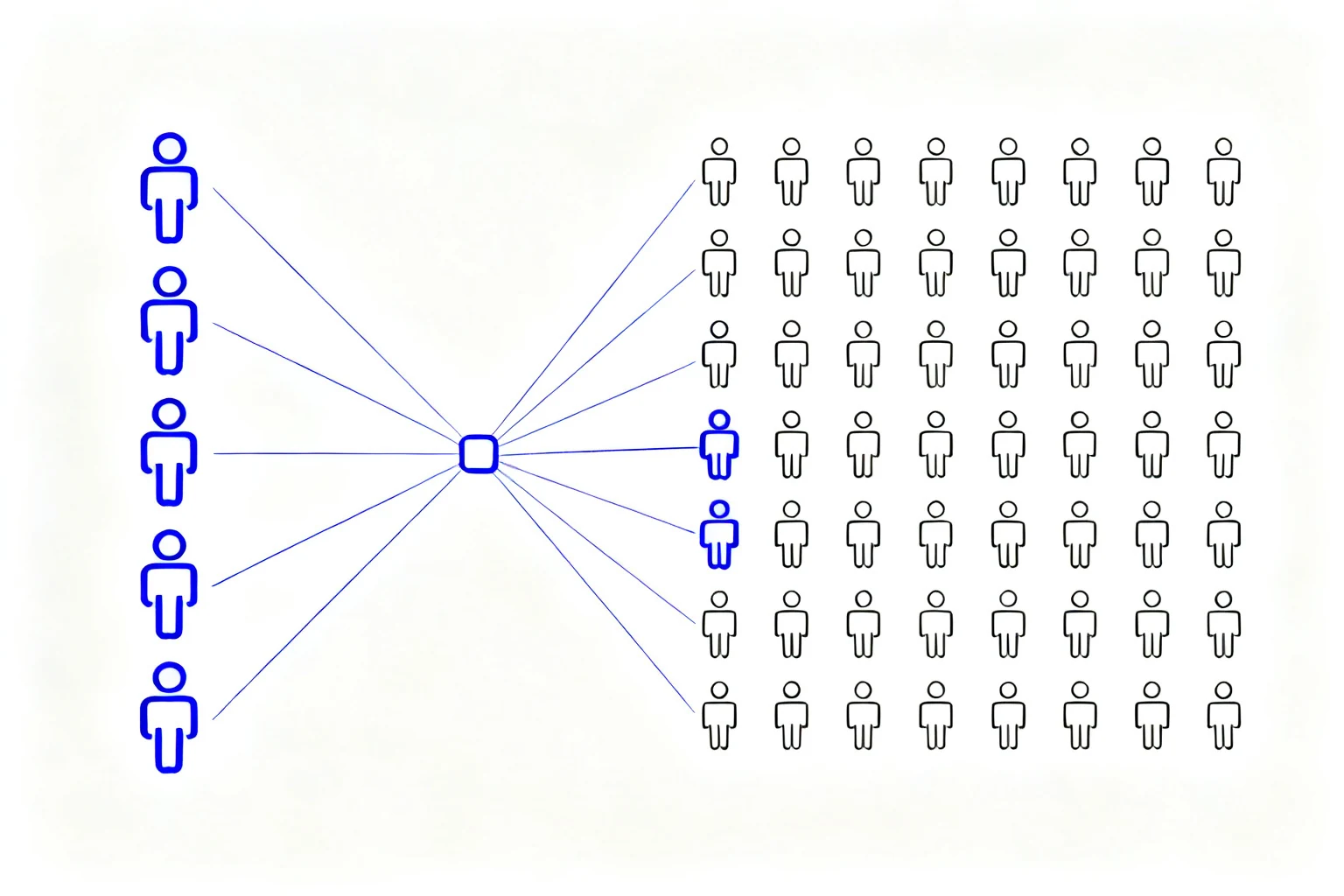
The insight that changes the economics: the 90% don’t need to become the 10%. They need to use what the 10% built.
Nobody at your company knows how the payroll system works internally. They still get paid. The competence is embedded in a system, not distributed to every head.
Do the same with AI. The fluent 10% stop being trainers and become builders. They configure the agent — the skills, the connectors, the guardrails, the escalation path. Everyone else just talks to it.
That requires one thing your current setup doesn’t have: a shared workspace where both populations touch the same agents.
Right now the 10% run their agents on their own laptop, in their own terminal, against their own API key. The work is real and it’s completely trapped. When that person is on holiday, the capability is on holiday.
What the shared workspace has to do
Not a chat UI with SSO. Four properties, and all four are load-bearing:
- Same agents for everyone. The AI employee your best operator built is in the sidebar of the intern who joined Monday. One agent, one config, many users. No personal fork.
- Skills as shared assets. When someone writes a skill that works, it lands in a library the whole org draws from. One person’s discovery is everyone’s baseline the next day. This is the company brain — the actual compounding asset.
- Connectors managed centrally. The 90% should never touch OAuth scopes or an MCP config. Admin wires the CRM once; every agent inherits access with the right permissions.
- Work in the open. Sessions, outputs and failures are visible, not buried in private chat histories. That’s how the 10% spot where the 90% are getting stuck — and how the 90% learn by reading real runs instead of a slide deck.
The mechanism is apprenticeship with the loop closed. The fluent build, the rest use, usage exposes failure modes, the fluent patch the skill, everyone gets the fix at once. Nobody attends a workshop.
The compounding argument
Two companies, same headcount, same model access, 12 months out.
Company A trains everyone. Each person gets marginally better at prompting. Nothing they learn survives their departure. The improvement is linear at best, and it resets with turnover.
Company B puts everyone in one workspace. Ten fluent people ship 40 skills over the year. Those skills run for 400 people. Each new hire’s day one starts at the org’s accumulated best practice instead of at zero. The improvement is per-skill, not per-person — so it compounds and it survives turnover.
The gap after 12 months isn’t 20%. It’s the difference between an org where AI is a personal habit and one where it’s infrastructure.
And here’s the leverage: when the next model lands — and it will, roughly every quarter — Company A has to re-teach 400 people. Company B upgrades the workspace and 40 skills get better overnight. Same argument I made in token count is the new headcount: the harness decides how much of each model jump you capture. The workspace is the harness at org scale.
What to do Monday
- Find your 10%. They’re already there, expensing their own Claude Max, running things nobody asked for. Name them. They’re not a side project anymore — building agents is part of the job description.
- Pick the three workflows that eat the most hours. Not the most impressive ones. The boring, repeated, high-volume ones — those are what skills are for.
- Have the 10% build them as agents, not as demos. Real connectors, real guardrails, a named internal owner for each.
- Put the 90% on those agents — not on a training course. Their job is to use it and report where it breaks.
- Measure adoption, not attendance. How many people ran an agent this week? How many skills exist? How many run on a schedule without a human? Those are the numbers that predict next year’s output.
The companies that win the next 18 months won’t be the ones with better models — everyone gets the same models within weeks of each other. They’ll be the ones that stopped waiting for 400 people to become AI experts and put those 400 people to work on the agents their best 40 already built.
If you want that mapped for your operation — who your 10% are, which workflows to convert first, what to stop training — that’s the audit I run. See the consulting page or book a 30-minute discovery call.
— Yoann
- ai-strategy
- ops
- openlabor